
8-Week Digital SAT Prep Course: How Structured Preparation Can Improve Your Score
Preparing for the SAT is no longer simply a matter of working through a large book of practice questions. The Digital SAT requires students to understand the material, manage their time effectively, adapt to the computer-based testing environment, and recognize the types of mistakes that are preventing them from reaching a higher score.
For many students, that requires more than a few practice sessions immediately before test day.
A structured Digital SAT prep course gives students time to identify weaknesses, strengthen specific skills, practice under realistic conditions, and measure whether their scores are actually improving.
Private LV Tutors is introducing a 8-week Digital SAT preparation program designed around that process. The course combines targeted preparation, practice testing, performance analysis, and continued academic support, with a goal of helping participating students achieve a significant measurable improvement in their SAT scores.
The program includes a 200-point score improvement guarantee. If a student does not reach the targeted increase during the program, Private LV Tutors will continue working with the student at no additional charge until the goal is achieved, according to the program’s participation requirements and terms.
Why Preparing for the Digital SAT Requires a Different Approach
The SAT is now administered digitally and uses an adaptive testing structure.
Students complete two major sections:
- Reading and Writing
- Math
Each section is divided into two modules. Performance during the first module influences the difficulty mix students receive in the second module.
This makes preparation somewhat different from simply learning a fixed collection of formulas, grammar rules, or testing tricks.
Students need to develop several abilities at the same time:
- Strong knowledge of tested concepts
- Accuracy under time pressure
- Familiarity with digital questions
- Efficient problem-solving strategies
- Careful reading and interpretation
- Consistent performance across different question types
- Confidence when encountering more difficult material
A strong SAT preparation plan therefore needs to do more than explain how to answer individual questions.
It needs to identify patterns in a student’s performance and systematically improve them.
Why Use a 8-Week SAT Prep Course?
SAT preparation is a process.
Students can certainly learn useful strategies in a short intensive course, but meaningful score improvement often depends on correcting weaknesses that have developed over several years of school.
Twelve weeks provides enough time to move through several important stages of preparation instead of trying to accomplish everything at once.
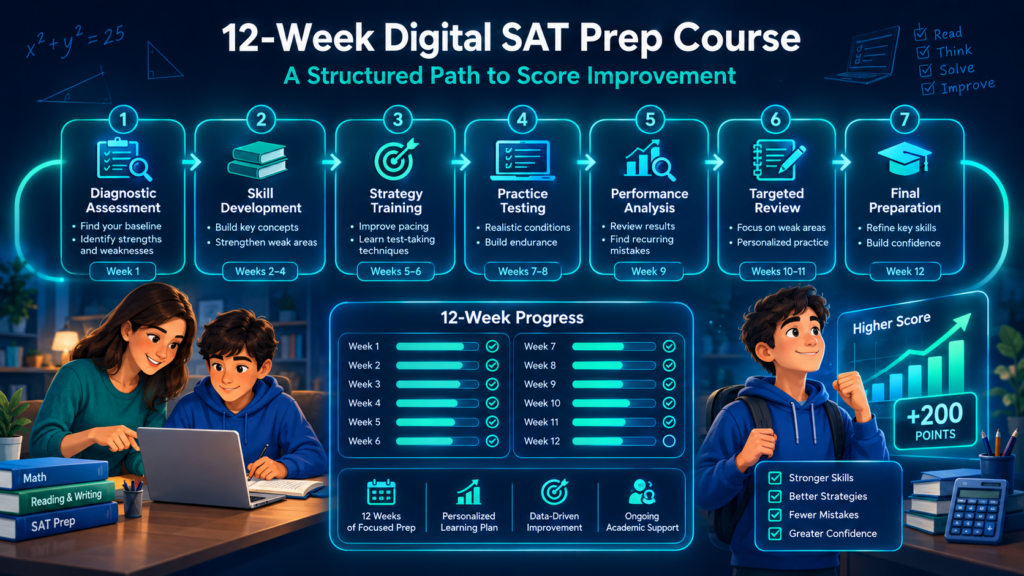
A structured preparation cycle may look like this:
| Preparation Stage | Main Goal |
| Initial Assessment | Determine the student’s starting point |
| Skill Development | Strengthen weak Math and Reading/Writing areas |
| Strategy Training | Improve pacing and question-solving techniques |
| Practice Testing | Apply skills under SAT-style conditions |
| Performance Analysis | Identify recurring mistakes and weaknesses |
| Targeted Review | Focus instruction on the areas affecting the score most |
| Final Preparation | Improve consistency and test-day confidence |
The major advantage of this approach is that instruction changes as the student progresses.
A student who initially struggles with algebra may later need more attention on advanced math problems. Another student may understand grammar well but consistently lose points on reading comprehension or questions requiring careful interpretation of evidence.
The preparation plan should respond to those differences.
Step 1: Establishing an Accurate Starting Point
One of the biggest mistakes students make is beginning SAT preparation without knowing exactly where they are losing points.
A diagnostic assessment helps establish a baseline.
Instead of simply looking at the total SAT score, tutors can examine performance by subject and question category.
For example, a Math score may be affected by weaknesses in:
- Algebra
- Advanced Math
- Problem-Solving and Data Analysis
- Geometry and Trigonometry
Reading and Writing performance may reveal different challenges involving comprehension, grammar, vocabulary in context, evidence, or interpretation.
Two students with the same overall score may therefore require completely different study plans.
That is why effective Digital SAT preparation should begin with diagnosis rather than assumptions.
Step 2: Fixing the Skills That Are Holding the Score Back
Once weaknesses have been identified, preparation becomes much more targeted.
Consider a student who repeatedly misses quadratic equation questions. Completing dozens of unrelated Math problems may not be the most efficient approach.
The student may need to revisit:
- Factoring
- Function notation
- Graph interpretation
- Equation manipulation
- Connections between different representations of quadratic functions
The same principle applies to Reading and Writing.
If a student consistently struggles with transitions, sentence boundaries, or identifying the purpose of a passage, those areas should receive more attention.
This is one of the major advantages of personalized SAT tutoring.
Instead of giving every student exactly the same assignments, instruction can focus on the specific skills most likely to improve that student’s performance.
Step 3: Learning How to Take the Digital SAT
Knowing the subject matter is essential, but students also need experience with the format of the exam.
The Digital SAT requires students to work efficiently within timed modules and make decisions about when to spend additional time on a difficult question and when to move forward.
Practice helps students develop better judgment.
Students gradually learn:
- How quickly they normally solve different question types
- Which problems tend to consume too much time
- When to return to a difficult question
- How to check work efficiently
- How to use available digital testing tools
- How to remain focused through the entire exam
These skills become much easier to develop when students repeatedly practice in conditions that resemble the actual test.
Step 4: Using SAT Practice Tests as a Diagnostic Tool
A practice test should not simply produce another score.
The most useful information often comes from what happens after the test.
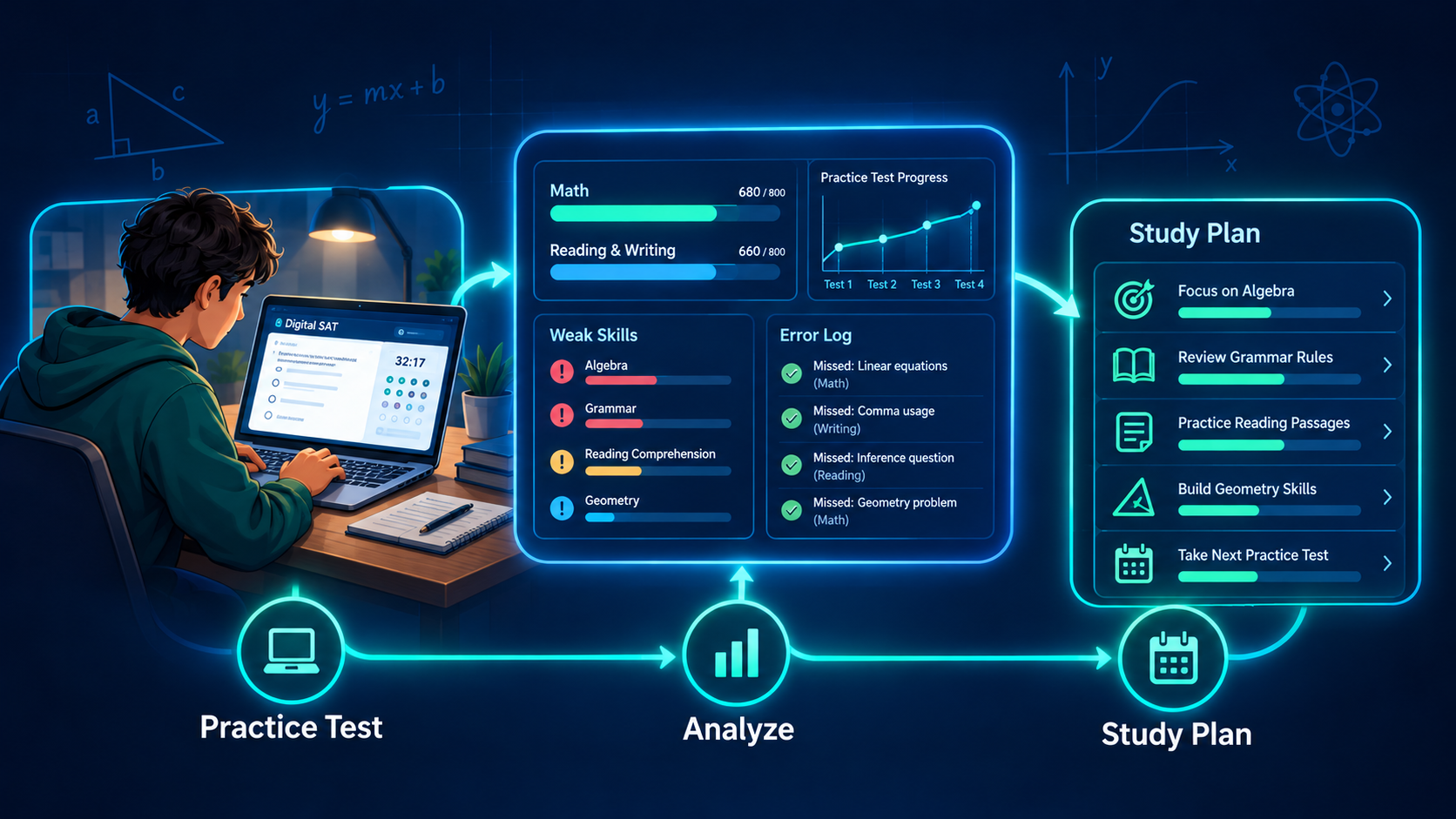
Detailed performance analysis can reveal patterns such as:
- Repeated errors in one Math topic
- Difficulty with higher-level questions
- Rushing near the end of a module
- Strong performance early in the test followed by declining accuracy
- Reading questions that consistently require too much time
- Grammar concepts that have not been fully mastered
These patterns give tutors something concrete to work with.
Instead of saying, “You need to improve Math,” the preparation plan can become much more specific:
“You are performing well in Algebra but losing points in Geometry and Trigonometry.”
That difference matters.
Students have limited preparation time, so the goal should be to spend that time where it can produce the greatest improvement.
Why Performance Analytics Can Make SAT Preparation More Efficient
Students often judge their preparation by how many questions they complete.
That is not necessarily the best measurement.
A student might complete 500 practice questions while repeatedly making the same mistakes.
Another student might complete fewer questions but carefully analyze each incorrect answer, identify patterns, and correct the underlying weaknesses.
The second approach can be far more productive.
Performance data can help answer questions such as:
- Which skills are improving?
- Which areas remain inconsistent?
- Are careless mistakes decreasing?
- Is pacing improving?
- Are practice scores trending upward?
- Which question categories should receive more attention next?
This creates a feedback loop:
Practice → Analyze → Identify Weaknesses → Target Instruction → Practice Again
Over several weeks, that cycle can make preparation increasingly precise.
What Does a 200-Point SAT Score Increase Require?
A 200-point improvement is a meaningful goal.
However, students begin SAT preparation from very different starting points, so there is no single study method that guarantees the same path for everyone.
A student starting at 1000 faces different challenges from a student already scoring 1350 or 1450.
Improvement may depend on factors such as:
- Starting score
- Existing academic foundation
- Attendance
- Practice consistency
- Completion of assigned work
- Number and type of learning gaps
- Time remaining before the official SAT
- Student motivation
That is why a score-improvement guarantee should be supported by an actual preparation process rather than presented as an expectation that students will improve automatically.
Private LV Tutors’ 8-week program is designed around a 200-point improvement goal and guarantee. Students who complete the program but have not yet achieved the targeted increase can continue receiving support at no additional charge until the score goal is reached, subject to the program’s participation requirements.
The purpose is to make SAT preparation outcome-focused rather than simply selling a fixed number of tutoring sessions.
Math Preparation for the Digital SAT
SAT Math evaluates several major areas of mathematics, including Algebra, Advanced Math, Problem-Solving and Data Analysis, and Geometry and Trigonometry.
Students may need to work on topics such as:
- Linear equations
- Systems of equations
- Functions
- Quadratic equations
- Exponents
- Ratios and percentages
- Data interpretation
- Probability
- Geometry
- Trigonometry
One of the advantages of a longer preparation period is the ability to revisit foundational concepts when necessary.
A student struggling with an advanced problem may actually have a much simpler underlying weakness.
Fixing that foundation can improve performance across several different question types.
Reading and Writing Preparation
The Reading and Writing section requires a combination of comprehension, reasoning, grammar, vocabulary, and interpretation.
Students may encounter difficulties because they:
- Read passages too quickly
- Misinterpret what a question is asking
- Choose answers that sound plausible but are not supported by the text
- Struggle with grammar conventions
- Have difficulty identifying relationships between ideas
- Spend too much time on individual questions
Preparation should therefore combine content knowledge with efficient reading and decision-making strategies.
Regular practice also helps students become more comfortable with the shorter passage and question format used on the Digital SAT.
Practice Between Tutoring Sessions Matters
Tutoring provides instruction and direction, but meaningful improvement also requires students to practice independently.
The strongest preparation programs create a balance between guided instruction and independent work.
Between sessions, students may be asked to:
- Review concepts covered with the tutor
- Complete targeted practice questions
- Rework missed questions
- Maintain an error log
- Practice timed question sets
- Review formulas or grammar rules
- Complete practice exams when assigned
The purpose is not simply to give students more homework.
Independent practice gives tutors additional performance information and helps determine whether newly learned skills can be applied without assistance.
Who Can Benefit From a Structured SAT Prep Program?
A 8-week SAT prep course may be especially useful for students who:
- Have taken the PSAT or SAT and want a significant score increase
- Are unsure how to organize their preparation
- Have noticeable weaknesses in Math or Reading and Writing
- Struggle with time management
- Have studied independently but reached a score plateau
- Need accountability to maintain a consistent study schedule
- Want more detailed feedback than a practice score alone provides
- Are preparing for an upcoming college admissions cycle
Students do not necessarily need to be struggling academically to benefit.
High-performing students may also need targeted preparation to move from a good SAT score to a highly competitive one.
Choosing a Digital SAT Prep Course
Parents and students evaluating SAT preparation options should look beyond the number of tutoring hours offered.
Useful questions include:
- Does the program begin with an assessment?
- Is instruction personalized?
- Are full-length or realistic Digital SAT practice tests included?
- Is performance analyzed by skill area?
- Does the program cover both Math and Reading/Writing?
- Is progress measured throughout the course?
- What happens if the student does not improve as expected?
- Does the student receive support between assessments?
Families looking for structured preparation can learn more about the SAT prep program in Las Vegas and available tutoring options through Private LV Tutors.
Building SAT Improvement Over 8 Weeks
SAT preparation becomes much more manageable when it is broken into measurable steps.
Instead of telling a student to “study harder,” a structured program can identify exactly what needs to improve, teach the necessary skills, measure progress through practice testing, and adjust instruction based on actual results.
That is the purpose of a 8-week Digital SAT prep course.
The goal is not simply to expose students to more SAT questions. It is to help them understand why they are losing points and systematically remove those obstacles before test day.
For students seeking a substantial score increase, consistent practice, individualized instruction, realistic testing, and detailed performance analysis can provide a much stronger preparation strategy than last-minute studying.
Frequently Asked Questions About Digital SAT Preparation
How long is the Digital SAT?
The SAT includes Reading and Writing and Math sections and takes a little over two hours of testing time, excluding the scheduled break.
Is 8 weeks enough time to prepare for the SAT?
For many students, 8 weeks provides enough time to establish a baseline, strengthen weak subject areas, practice SAT-style questions, complete practice testing, and make adjustments before the official exam. The amount of preparation required will still depend on the student’s starting point and target score.
Can a student improve an SAT score by 200 points?
A 200-point increase is possible, but the amount of improvement varies by student. Starting score, academic weaknesses, study consistency, attendance, and available preparation time can all influence results.
Private LV Tutors’ new program is structured around a 200-point improvement guarantee, with continued support for eligible students who have not reached the target during the initial course period.
Are practice tests important for Digital SAT preparation?
Yes. Practice tests help students become familiar with timing and question formats while also providing valuable information about strengths and weaknesses. The most useful preparation involves analyzing the results rather than simply recording the final score.
Should SAT preparation focus more on strategy or academic skills?
Usually both.
Testing strategies can improve pacing and decision-making, but they cannot replace missing academic knowledge. Students with foundational weaknesses often need direct instruction in Math or Reading and Writing concepts alongside test-taking strategies.
When should a student begin preparing for the SAT?
The best starting point depends on the student’s current score, target score, and planned test date. Students seeking a substantial improvement generally benefit from starting early enough to allow several cycles of instruction, practice, assessment, and targeted review rather than relying on intensive preparation immediately before the exam.


