
Why Digital SAT Practice Tests Matter: Using Results to Build a Better Study Plan
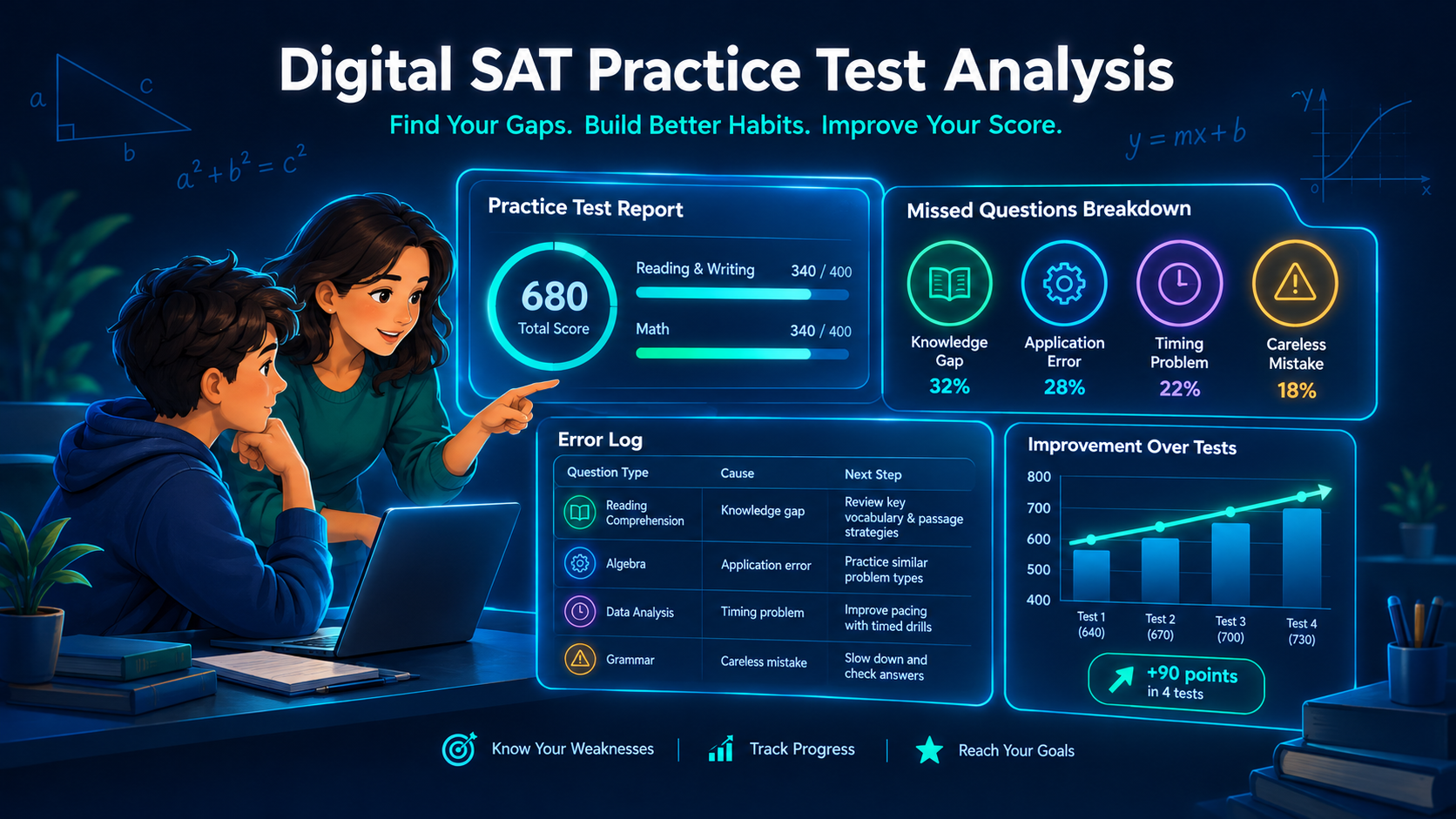
Digital SAT practice tests are one of the most useful tools available to students preparing for the exam.
But simply taking more tests does not guarantee a higher score.
The real value comes from using each practice test to identify weaknesses, understand recurring mistakes, and decide what to study next.
A strong SAT preparation plan should therefore treat practice tests as more than score checks. They should be used as diagnostic tools that help students make their study time more focused and productive.
What a Digital SAT Practice Test Can Reveal
A practice test provides much more information than a total score.
It can help students see:
- Which Math topics cause the most difficulty
- Which Reading and Writing skills need improvement
- Whether timing is becoming a problem
- Where careless mistakes are occurring
- Which question types consistently take too long
- Whether performance is improving over time
Two students with the same total score may have completely different weaknesses.
One student may lose most of their points in Math, while another may perform well in Math but struggle with grammar and reading comprehension.
That is why preparation should be based on individual test results rather than a generic study plan.

Why Official Digital Practice Matters
Students preparing for the Digital SAT should become comfortable with the same type of testing environment they will encounter on test day.
Official full-length Digital SAT practice tests are available through College Board’s Bluebook application.
These tests help students become familiar with:
- The digital interface
- Timed modules
- Navigation between questions
- Built-in testing tools
- The adaptive structure of the exam
This familiarity matters because students should not be learning how the testing platform works during the actual SAT.
The more comfortable they are with the format, the more attention they can devote to answering questions correctly.
A Practice Score Is Only the Starting Point
Students often finish a practice test, look at the score, and immediately decide whether they are satisfied.
That is understandable, but it misses the most important part of the exercise.
Instead of asking only:
“What did I score?”
students should also ask:
- Why did I miss each question?
- Which mistakes appeared more than once?
- Was the problem caused by a knowledge gap?
- Did I misunderstand the question?
- Did I run out of time?
- Was the mistake careless?
- Did I know the concept but apply it incorrectly?
These questions turn a score report into a study plan.
Separate Knowledge Gaps From Test-Taking Mistakes
Not every incorrect answer has the same cause.
This distinction is important because different problems require different solutions.
Knowledge Gap
The student does not understand the underlying concept.
For example:
- Cannot solve a system of equations
- Does not understand a grammar rule
- Struggles with percentages
- Does not recognize how transitions connect ideas
The solution is usually additional instruction and targeted practice.
Application Error
The student knows the concept but uses it incorrectly.
For example, the student understands quadratic equations but makes an algebraic mistake while solving one.
The solution may involve slower, more deliberate practice.
Timing Problem
The student understands the question but spends too much time solving it.
The solution may involve improving efficiency or changing the order in which questions are approached.
Careless Mistake
Examples include:
- Misreading a question
- Entering the wrong number into a calculator
- Ignoring a negative sign
- Selecting an answer before checking the full passage
Careless mistakes often require better checking habits rather than additional academic instruction.
Identifying the reason behind each mistake makes SAT preparation much more efficient.
Use an Error Log
One simple way to get more value from SAT practice tests is to maintain an error log.
After each test or practice set, record:
| Item | What to Record |
| Question Type | Algebra, grammar, reading inference, etc. |
| Mistake | What went wrong |
| Cause | Knowledge, timing, careless error, misunderstanding |
| Correct Approach | How the problem should have been solved |
| Follow-Up | What needs additional practice |
After several weeks, patterns usually become easier to see.
A student may discover that many mistakes come from the same three or four areas.
Those areas should become priorities in the study plan.
Turn Test Results Into Targeted Practice
Suppose a student’s practice results show:
- Strong Algebra performance
- Weak Geometry and Trigonometry
- Good grammar accuracy
- Frequent errors on Reading and Writing inference questions
The student’s next study week should not consist of random SAT questions.
Instead, the plan might include:
- Review Geometry fundamentals
- Complete targeted Trigonometry questions
- Practice Reading and Writing inference questions
- Review mistakes from the most recent test
- Complete one timed module later in the week
This is much more efficient than giving equal attention to every topic.
Do Not Take Full-Length Tests Too Frequently
More practice tests are not always better.
Students need enough time between full-length tests to actually correct what the previous test revealed.
A useful cycle is:
Take a Test → Analyze Results → Study Weak Areas → Practice Targeted Skills → Retest
If a student takes another full-length test immediately without correcting the weaknesses from the first one, the same mistakes are likely to appear again.
Full tests are most valuable when they are part of a larger preparation process.
Track Trends, Not Just Individual Scores
One practice score can be affected by many factors.
A student may be tired, distracted, unusually confident, or simply encounter a group of questions that matches their strengths or weaknesses.
For this reason, progress should usually be evaluated across several assessments.
Useful trends to monitor include:
- Total score changes
- Math score changes
- Reading and Writing score changes
- Accuracy by question type
- Number of careless mistakes
- Pacing problems
- Performance in weaker skill areas
If the overall score stays similar but the student is making fewer mistakes in a previously weak area, progress may still be happening.
The next step is to determine where the remaining lost points are coming from.
How Tutors Can Use Practice-Test Data
Practice-test results can also make tutoring more personalized.
Instead of spending equal time on every SAT topic, a tutor can use performance data to determine what needs the most attention.
For example, a tutor may notice that a student:
- Understands most Math concepts but struggles with pacing
- Repeatedly misses advanced algebra questions
- Performs well in Reading but loses points on grammar
- Makes more errors late in each module
- Needs foundational review before continuing with advanced practice
This allows tutoring sessions to become more focused.
In a structured Digital SAT preparation program, practice tests can therefore serve as checkpoints that help determine what should be taught next.
Practice Tests Can Also Build Confidence
Practice testing is not only about finding weaknesses.
It can also show students what they are doing well.
When students see that:
- A previously difficult Math topic has improved
- Timing is becoming more comfortable
- Certain errors have disappeared
- Scores are gradually increasing
they gain evidence that their preparation is working.
That can be especially valuable for students who feel anxious about the SAT.
Confidence is stronger when it comes from measurable progress rather than reassurance alone.
Combine Official Tests With Targeted Practice
Full-length tests should be combined with shorter, focused practice.
Students may use:
- Full Digital SAT practice tests
- Timed modules
- Subject-specific question sets
- Skill-specific exercises
- Review of missed questions
- Tutor-assigned practice
College Board also provides targeted practice resources after students complete official Bluebook tests, allowing preparation to focus on skills identified through their results.
The strongest study plan usually combines realistic testing with targeted work between assessments.
Making Every Practice Test Useful
A Digital SAT practice test should answer three questions:
- Where am I now?
- Why am I losing points?
- What should I study next?
If students can answer those questions after each assessment, practice testing becomes much more valuable.
The goal is not to complete the largest possible number of tests.
The goal is to use each test to make the next stage of preparation more precise.
Students who consistently test, analyze, correct, and retest can gradually replace weak areas with stronger skills and approach the SAT with a much clearer understanding of what they need to do.
Frequently Asked Questions
How many Digital SAT practice tests should a student take?
There is no ideal number for every student. The important factor is leaving enough time between tests to review mistakes and improve weak areas.
Are official Digital SAT practice tests better?
Official practice tests are especially useful because they closely reflect the actual Digital SAT experience and allow students to practice within the Bluebook environment.
Should students review every incorrect answer?
Yes. Students should understand why an answer was wrong and what they should do differently next time.
Can practice tests improve an SAT score?
Practice tests can support improvement when students use the results to identify weaknesses and guide future study. Simply taking repeated tests without reviewing them is much less effective.
What should students study after a practice test?
The next study plan should focus primarily on recurring weaknesses, knowledge gaps, pacing problems, and question types where the student consistently loses points.


